FIP HumanityRx is FIP’s humanitarian programme, showcasing the support FIP can provide to pharmacists and pharmacy teams in times of crisis. Pharmacists often play vital roles by ensuring the distribution of medicines to patients and offering guidance on stock management.
This programme will showcase the different humanitarian initiatives carried by pharmacists across the globe to demonstrate how adaptable the profession is depending on the crisis at hand and how colleagues can be more involved in supporting healthcare delivery in disaster and emergency settings, also highlighting the interprofessional collaboration among healthcare professionals in humanitarian arenas.
At FIP, we wish to support the profession in countries during a crisis and create awareness of pharmacists’ roles in disasters and emergencies, using their communities as support frameworks to ensure the profession’s preparedness. The Military and Emergency Pharmacists Section (MEPs) has been working in managing emergencies for years. Nevertheless, as we see the impact of crises in increasingly fragile environments, it is paramount that pharmacists continue the work post-emergency and provide sustained humanitarian support, which can be achieved in many ways. Examples for all to see and select from will be compiled. In addition to showcasing examples of crisis management and humanitarian support, FIP will maintain a list of available resources and content.
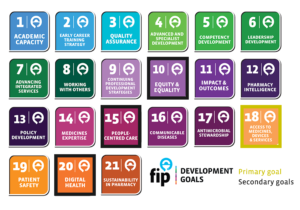
The humanitarian programme is mainly linked to the FIP Development Goal 18 – Access to medicines, devices and services as one important aspect of disaster and emergency situations is the continuation of treatment and access to safe and effective medicines. Other related goals include FIP Development Goal 10 – Equity and equality, FIP Development Goal 15 – People centred care and FIP DEvelopment Goal 20 – Digital health.
“Let us stand shoulder to shoulder and support each other around the world,” is the message from a group of humanitarian pharmacists gathered by FIP. FIP is proud to have supported a number of colleagues to continue to provide pharmaceutical care in a number of places affected by disasters this year. However, during our work, we have identified gaps, such as the lack of specific training for pharmacists and awareness on how they can be more engaged, and FIP will be working to address these as part of its commitment.
FIP’s Role in Humanitarian Activities
The occurrence of crises and disasters, whether natural or man-made, is both unpredictable and unexpected. We have always experienced disasters, wars, and economic and social conflicts across the globe. These crises directly impact the daily lives of entire populations, and healthcare is affected and compromised during these times.
Management of such situations from the pharmacy perspective is crucial to guarantee people can continue their treatment regimens and have access to essential healthcare services, including prevention and education. The access to medicines and services is a key area of work for FIP, as highlighted by the FIP Development Goal 18.
Our Actions and Initiatives
FIP is committed to:
- Support pharmacy associations with an overview of the skills that pharmacists might need when working in disaster preparedness or emergency situations.
- Liaise with national ministries of health and other relevant stakeholders to increase the impact and outcomes for pharmacists working in these settings.
- Create visibility for this specific role pharmacists can also have to encourage colleagues around the world to engage in humanitarian activities.
- Share among FIP member organisations any opportunities for engagement and success stories in these areas, promoting cross-collaboration.
- Continue to engage our stakeholders and empower our regional and national leaders and stakeholders to strengthen humanitarian work.
- Promote interprofessional collaborative work in humanitarian settings.
- Make available any resources or those essential for humanitarian work.
The Role of Pharmacists in Humanitarian Response
Pharmacists and their teams play a critical role in the management of the supply chain for medicines and vaccines in these situations. They ensure the responsible use of medicines and help avert uncertainty in these situations. Pharmacists can also play a vital role in preventing antimicrobial resistance.
To achieve the best possible outcomes for populations in disasters and crises, pharmacists work together with other healthcare professionals and community members to establish trust and provide the best available care to those communities.
Skills and Competencies for Humanitarian Practice
Acknowledging that current training opportunities for pharmacists working in a humanitarian arena are limited, FIP developed a global humanitarian competency framework with the World Health Organisation to support the global overview of the needed competencies.